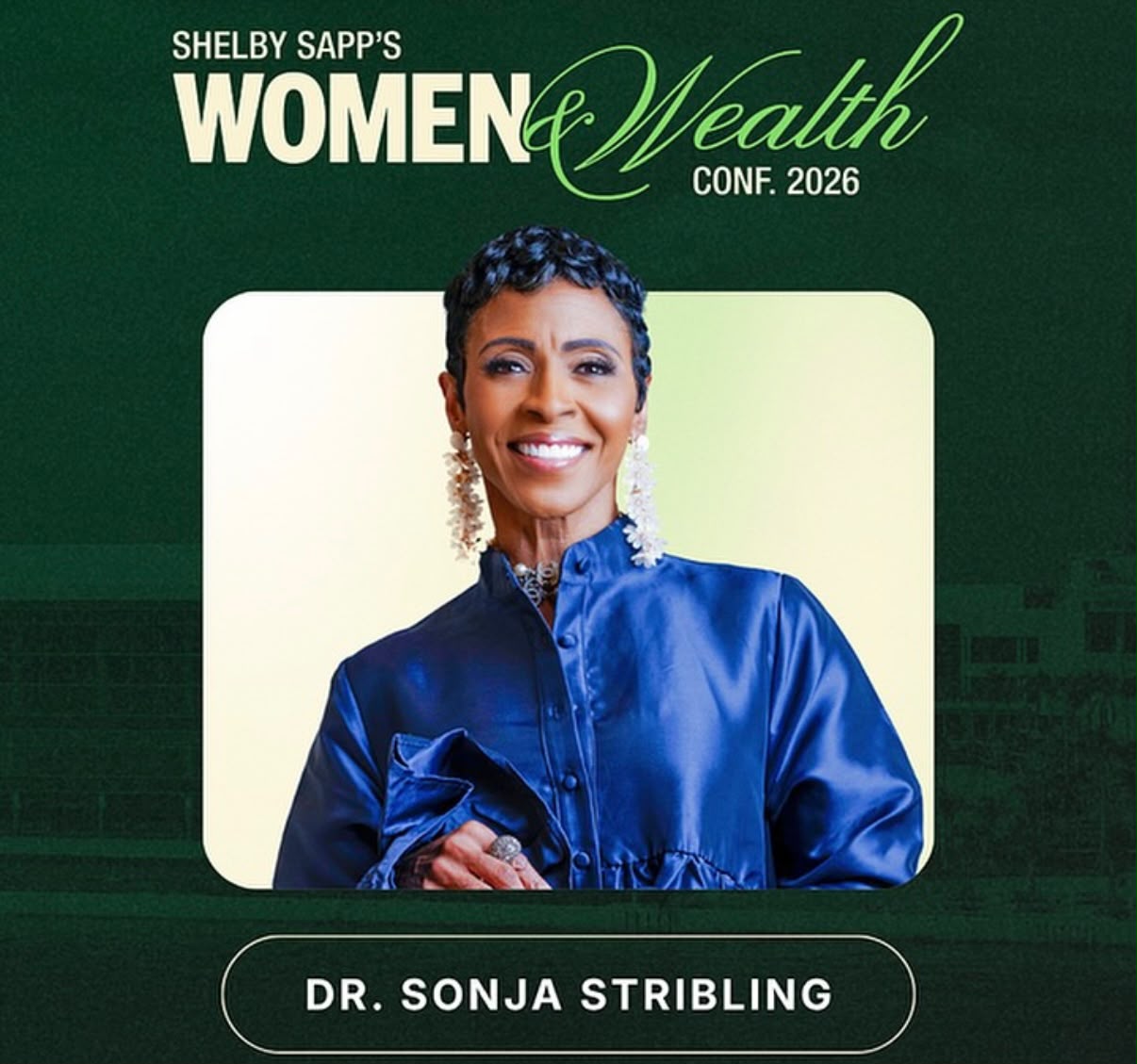
Dr. Sonja Stribling returned to the Women & Wealth stage with a question I have continued thinking about since.
Who is catching you?
Not who loves you.
- Not who agrees with you.
- Not who tells you everything will be okay.
- Not who keeps you comfortable.
Who can you trust enough to run at full speed, because you know that person will be waiting at the finish line?
Her first presentation was about intentionally designing the woman we are becoming.
This one was about what happens when that woman actually starts moving.
And Sonja's argument was that very few of us reach full speed alone.
What made this presentation the most interesting one to write about is that it did not end with the lesson. It ended with an offer. Which means the whole thing became a live demonstration of the exact ideas it was teaching.
Catching Kayla
Sonja built much of the presentation around the story of Kayla Montgomery.
Kayla was diagnosed with multiple sclerosis as a teenager.
She had been playing soccer, but because it was a contact sport, she eventually had to give it up. She turned to running.
There was one major complication.
As Kayla's body temperature increased during a race, she could temporarily lose sensation in her legs.
- She could still run.
- She simply could not feel the legs doing the running.
At the finish line, she could not reliably slow herself down and stop.
So her coach would be there.
- She ran through the line.
- And he caught her.
That image became Sonja's metaphor for the entire presentation.
Kayla could run as hard as her body allowed because she trusted who was waiting for her.
And Sonja asked us the obvious question.
Who is doing that for you?
The Person Who Loves You Most May Not Be the Person Who Pushes You Most
This was an important distinction, and I think it is the most durable idea in the talk.
Our families and closest friends often want what is safest for us.
That comes from love.
But safety and growth do not always point in the same direction.
If someone we love is exhausted, hurting, embarrassed, losing money, struggling through a launch, or hearing repeated rejection, the natural response is protective:
- Stop.
- You have done enough.
- You do not need this.
- Come home.
A good coach may respond differently.
- You told me you wanted this.
- Are you still committed to the goal?
- If yes, what needs to change?
- Where are you weak?
- What are you avoiding?
- What is the next repetition?
- Keep going.
That does not make the coach more caring than the friend. They occupy different roles.
There are moments when we need comfort.
There are other moments when comfort is the exact thing keeping us from finding out what we are capable of.
Accountability Is Not Someone Believing Everything You Say
Sonja emphasized repeatedly that Kayla specifically wanted a coach who would hold her accountable.
That word gets used casually in business.
- Accountability partner.
- Accountability group.
- Accountability coach.
But real accountability is uncomfortable.
It is not someone texting:
You got this!
It is someone saying:
- You told me this would be done Friday. It is Monday. What happened?
- You said you wanted a million in revenue. Your current sales activity cannot mathematically produce a million. What are we changing?
- You said you wanted to delegate. Why are you still approving everything?
- You said you wanted financial freedom. Why did your spending rise every time your income did?
That is accountability.
It connects what we say we want with what we are actually doing.
Most of us could use more of it.
But Choose Carefully Who Earns the Right to Push You
There is another side to this. The answer is not simply:
Get a coach.
Kayla trusted her coach because he understood the sport, understood her condition, understood her goals, had demonstrated competence, and had spent years helping her improve.
That matters, and it is the part of the metaphor most likely to get skipped.
- Someone being confident does not make them competent.
- Someone calling themselves a coach does not mean they understand your business.
- Someone having more followers does not mean they should influence your financial decisions.
- Someone having made money in one business model does not mean the same strategy applies to yours.
Before giving anyone meaningful influence over my decisions, I would ask:
- Do they understand where I am trying to go?
- Have they actually helped people solve this particular problem?
- Can they explain their methodology, or only their results?
- Will they tell me when my idea is bad?
- Are their incentives aligned with mine?
- Do they understand the downside as well as the upside?
- Can they tell the difference between pushing me through fear and pushing me into something stupid?
The right coach helps you run faster.
The wrong coach helps you reach the wrong destination faster.
What Are You Willing to Sacrifice?
Sonja then asked the room a question that deserves serious thought.
What are you willing to sacrifice to win?
Every meaningful goal carries a cost.
- Money.
- Time.
- Comfort.
- Status.
- Sleep, during certain seasons.
- Being misunderstood.
- Leaving an environment you have outgrown.
- Saying no to opportunities that conflict with the bigger goal.
The mistake is believing we can choose the result while avoiding every cost attached to producing it.
But I want to add two things.
Then Sonja Put Cash on the Stage
The second lesson came through another physical demonstration.
Five business owners stood on stage. Sonja had cash available in front of them.
These women had already said they believed people valued what they offered and wanted to pay them.
But when money was physically available, they hesitated.
Eventually one woman took $100.
- Another took $20.
- Another $10.
- Another $5.
- The final woman received $1.
Then Sonja asked them why.
The answers were the interesting part.
- One questioned whether she had the right to simply take the money.
- Another was busy listening for further instructions.
- Another overthought it.
- One connected the $5 she received with her habit of undercharging in her business.
- The woman who got $1 said she thought she needed to be polite.
Sonja called the lesson:
First takers advantage.
The person willing to move first had access to the largest opportunity.
How Often Does Politeness Become Economic Hesitation?
I think there is something genuinely relevant here for women.
We are often rewarded socially for being:
- Patient.
- Agreeable.
- Non-disruptive.
- Considerate.
- Not too demanding.
- Not too loud.
- Not too ambitious.
- Not too transactional.
Those qualities can be real strengths.
But translated incorrectly into business, they become:
- Not asking for the sale.
- Not negotiating.
- Undercharging.
- Waiting for someone else to speak.
- Letting another person take the opportunity.
- Not asking what the compensation is.
- Accepting unfavorable terms to avoid seeming difficult.
- Waiting to be invited.
The lesson is not to become rude.
It is to notice when politeness has quietly become permission-seeking.
There is nothing impolite about knowing your value.
Speed Is Genuinely Valuable
Sonja told the audience repeatedly that the market rewards people who move.
Sarah Perl had made almost the same argument in the previous presentation, and there is plenty of truth in it.
Speed matters when:
- A trend is emerging.
- Distribution is temporarily cheap.
- A customer is ready.
- A competitor is slow.
- An opportunity has a deadline.
- A product can be tested inexpensively.
- A decision is reversible.
- A relationship needs following up.
The difference between thinking about something for three months and testing it this afternoon can be enormous.
But speed is not universally intelligent.
That became especially relevant during the final section.
The Presentation Became a Live Sales Lesson
After teaching first takers advantage, Sonja transitioned into an offer.
Women & Wealth and Sonja were launching a four-month program called She Transforms Mastermind. There were two levels. One was presented at $15,000. The elite level was $25,000, with only 50 spots.
Women began moving toward the stage before the pitch was fully complete.
- Folders were distributed.
- Forms were handed out.
- People lined up.
The room became intentionally chaotic.
From a sales perspective it was fascinating, because nearly everything we had discussed across the entire conference showed up at once.
- Identity.
- Urgency.
- Scarcity.
- Social proof.
- Price anchoring.
- Public commitment.
- Movement.
- Community.
- Fear of missing out.
- Speed.
- And the framing that the person who acts first receives more.
It was a masterclass in how environment shapes purchasing behavior.
High-Ticket Decisions Deserve a Different Speed
This is where two useful ideas have to be separated.
Move quickly on opportunity.
And:
Make expensive decisions quickly.
They are not the same thing.
- Posting a video today instead of next month has limited downside.
- Testing a landing page is reversible.
- Calling the customer now is probably just sensible.
Investing $15,000 or $25,000 is materially different.
For some women in that room, $25,000 is an insignificant portion of liquid net worth. For another, it is most of her savings.
The identical purchase can be rational for one woman and reckless for another.
A serious investor is capable of enthusiasm and diligence at the same time.
Before any high-ticket education, coaching, or mastermind purchase, I would want to know:
- What exactly is being delivered?
- Who specifically delivers it, and how often?
- What measurable business problem am I trying to solve?
- Could I solve that same problem for materially less?
- What results are actually documented, beyond testimonials?
- What is the refund or cancellation policy?
- What does the contract say, in writing?
- What happens if my circumstances change?
- What additional costs will implementation require?
- What economic outcome would make this worthwhile for me specifically?
If the opportunity survives those questions, wonderful. Move.
And if a seller treats those questions as a lack of belief, that is information too. Anyone confident in what they are delivering can withstand being asked what it is.
Fast Does Not Mean Impulsive
I think this distinction improves Sonja's lesson rather than contradicting it.
The best entrepreneurs I know are often extraordinarily fast.
They are not reckless.
They know which decisions deserve seconds and which deserve weeks.
They move immediately on reversible decisions. They slow down when:
- Giving away equity.
- Signing a major lease.
- Taking on substantial debt.
- Entering a partnership.
- Acquiring a company.
- Committing a significant percentage of personal liquidity.
That is not fear. That is judgment.
The goal is to eliminate unnecessary hesitation without eliminating necessary diligence.
Those are very different things, and the room makes them hard to tell apart.
First-Taker Advantage Is Real, and So Is First-Mover Risk
Moving first can produce better pricing, distribution, partnerships, attention, market share, and learning.
But first movers also absorb the mistakes.
- They educate the market.
- They discover the regulatory problems.
- They pay to develop the processes competitors later copy for free.
Sometimes the second mover acquires everything the first mover learned at a fraction of the cost.
So I would slightly rewrite the principle:
Develop a bias toward action, not a religion around being first.
Move because the opportunity makes sense. Not because someone else might move before you.
The Best Accountability Eventually Makes You Stronger Without the Coach
There was one more idea inside the Kayla story that I keep returning to.
A great coach catches you.
But she also teaches you to run.
The goal should never be permanent dependency.
- The coach should sharpen your judgment.
- Build your skills.
- Increase your confidence.
- Expose your blind spots.
- Help you build systems.
Eventually, decisions you once needed help making should become decisions you can make alone.
That is a demanding standard for any mentor, mastermind, consultant, or advisor. After twelve months of working together:
Am I more capable, or simply more dependent?
It may be the single best test of whether coaching is actually working.
Turning the Whole Thing Into Decision Criteria
If I compress this presentation and my own reservations about it into a set of swaps, here is what I am left with.
Who supports me?
Who tells me the truth and still expects me to finish?
I need a coach.
I need this specific problem solved by someone who has solved it.
What am I willing to sacrifice?
What am I not willing to sacrifice? Decided before I walk in.
Hesitation is my weakness.
Hesitation is a tool. It belongs on expensive, irreversible decisions.
Move first.
Move when moving creates a real advantage.
Is this a good opportunity?
Is this a good opportunity for me, at my numbers, this quarter?
Do I believe in this?
What would have to be true for this to pay for itself?
Am I committed?
Am I becoming more capable, or more dependent?
What I'm taking from Dr. Sonja Stribling's second presentation
- 01Ambitious people need accountability, not just encouragement.
- 02The person who loves you most is not automatically the person best equipped to coach you.
- 03Give influence only to people who have earned it through competence, alignment, and judgment.
- 04Keep at least one accountability relationship with no invoice attached to its honesty.
- 05Connect what you say you want with the actions that would actually produce it.
- 06Accept the necessary costs of ambition without romanticizing unnecessary suffering.
- 07Decide what you are not willing to sacrifice before you enter a room designed to move you.
- 08Notice when politeness, overthinking, or permission-seeking is costing you money.
- 09Become comfortable asking for money and stating your value plainly.
- 10Develop a bias toward action on reversible, low-downside decisions.
- 11Do not confuse decisiveness with impulsiveness.
- 12High-ticket purchases deserve economic diligence, especially in emotionally powerful rooms.
- 13Learn to recognize urgency, scarcity, social proof, identity, and public commitment while they are working on you.
- 14Separate the value of an offer from the energy in the room around the offer.
- 15Move first when being first creates a real advantage, not because movement itself feels powerful.
- 16Choose coaches who make you increasingly capable of running without them.
So, Who's Catching You?
That is still the question I left with.
Because doing everything alone is overrated.
There are moments when another person sees our capacity more clearly than we can. A great coach can say:
- You are capable of another lap.
- You are avoiding the real problem.
- Your numbers do not support your story.
- Your price is too low.
- You are hiding.
- You are moving too slowly.
Or sometimes:
- You are moving too fast.
- Stop.
- Look at the contract.
- Run the numbers.
- Ask another question.
That is what real accountability looks like.
Not pushing us in one direction regardless of circumstances. Helping us become capable of making better decisions at higher speeds.
Sonja asked us who would catch us if we ran as hard as we possibly could. I think the second question matters just as much:
Do I trust the person at the finish line enough to run that fast?
Because speed becomes powerful when it is paired with direction, judgment, and the right people.
Without those, faster is simply faster.
This Is Part Ten
This is Part Ten of my Women & Wealth conference series.
There is something fitting about Sonja both opening and closing it for me. Her first presentation asked which version of myself gets to lead. Her second asked who is there when that version finally runs.
Her second presentation pulled the whole conference together.
- Identity.
- Action.
- Sales.
- Coaching.
- Money.
- Community.
- Speed.
- And transformation.
But the lesson I am carrying home is not simply:
Move faster.
It is more precise than that.
Stop hesitating where hesitation serves no useful purpose.
- Move on the call.
- The conversation.
- The idea.
- The follow-up.
- The opportunity you already understand.
And when a decision is large enough to materially change your finances, your business, or your life?
Be decisive enough to ask every hard question before you say yes.
That is not moving slowly.
That is learning how to move intelligently.
And perhaps that is what becoming her eventually requires.
Topics
- Women & Wealth
- Accountability
- Coaching
- High-Ticket Sales
- Sonja Stribling
Naihomy Navarro
Faith. Discipline. Elevation.
I write from Santo Domingo about building with intention: business, wealth, identity, and the decisions that hold everything else up.
Let's build something that lasts
If these ideas resonate, let's talk about collaborations and partnerships.
Connect