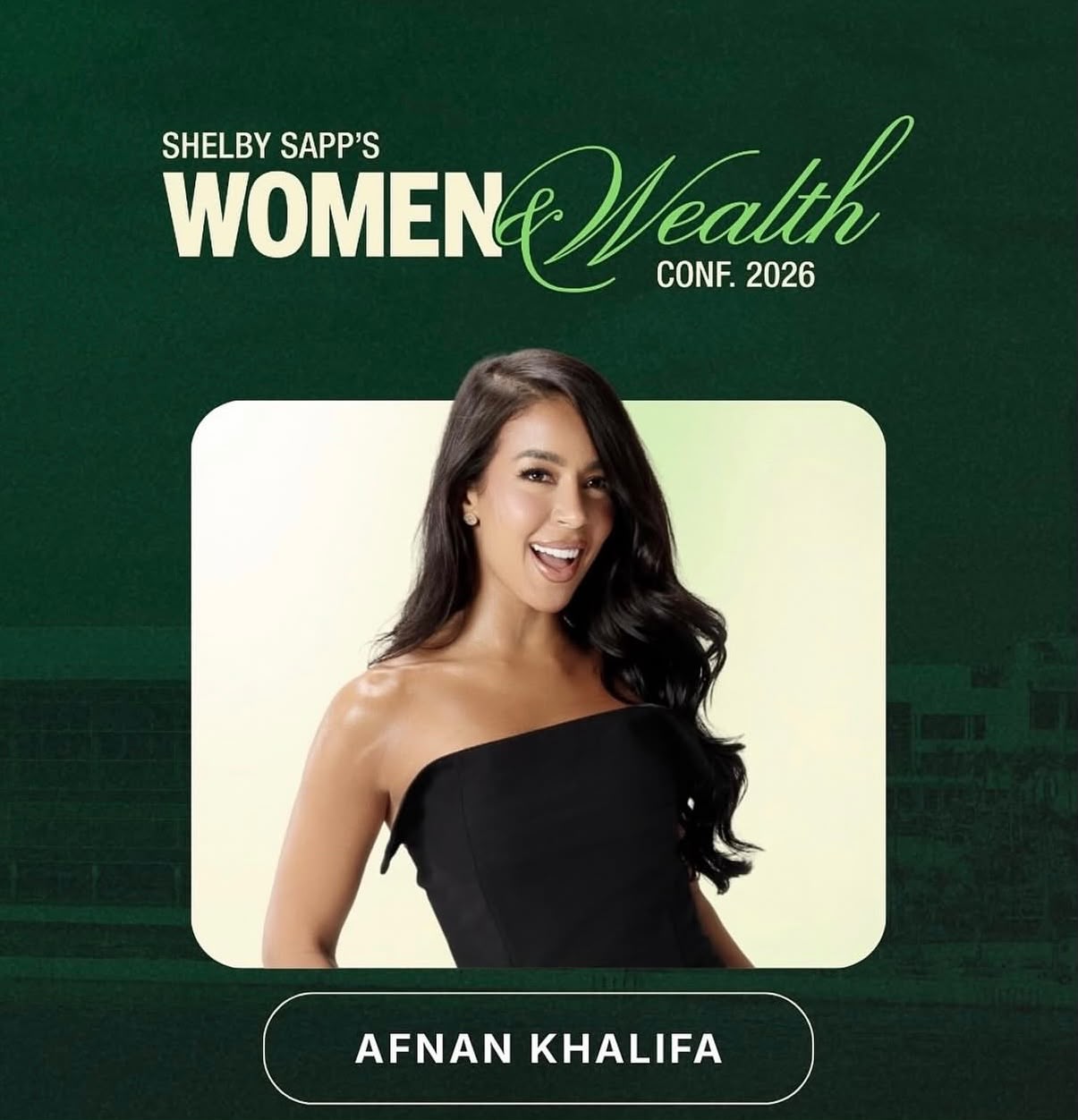
Five years ago, Afnan Khalifa was working as a waitress, making roughly $2,500 a month.
She was ambitious.
- She invested in herself.
- She attended rooms like Women & Wealth.
- She believed she had something valuable to offer.
But nobody knew who she was.
- Nobody was inviting her onto stages.
- Nobody was asking her onto podcasts.
- Nobody was associating her name with a particular expertise.
Afnan eventually decided the problem was not her value. It was her distribution.
The market cannot reward value it cannot see.
You can be extraordinarily talented. You can know more than the person with a million followers, give better advice, build a better product, get better results, have the stronger idea.
But if nobody knows you exist, the market never gets the chance to reward any of it.
Her presentation was about solving that problem. Not how to become internet famous. How to build a name that means something specific to the right people.
The Best Store in the World, in the Middle of the Desert
Afnan gave the audience a simple picture.
Imagine two stores.
The first has incredible products. Beautiful clothing, exceptional design, everything about the product is better. But the store sits in the middle of the desert.
The second store is merely good. But it sits in the middle of New York City.
Which one sells more?
Probably the one with the foot traffic.
- The first store has value.
- The second has distribution.
That is how Afnan wants us to think about social media. Attention is the new location. The internet lets almost anyone put her store on one of the busiest streets in the world.
And yet a surprising number of talented people build something excellent, place it somewhere nobody walks past, and then wonder why the market is not responding.
High Value Plus Low Visibility Equals Invisible Potential
This was my favorite equation in the presentation.
High value + low visibility = invisible potential.
People around you may know you are talented. Your friends know. Your customers know. Your family tells you how great you are.
But potential is not the same thing as market position.
There is an economic difference between:
- Being good.
- And being known for being good.
Afnan was careful to warn against the opposite mistake too. High visibility without meaningful value creates temporary attention. We all know people online who generate enormous views without building much trust or commercial longevity.
Which produces a useful pair of limits.
- Visibility alone is not the goal.
- Value alone is not enough.
- You want both.
The Real Asset Is the Name
Afnan said something that sounded at first like a branding statement and is actually a business statement.
Your greatest asset is not Instagram. It is not TikTok. It is not YouTube.
It is your name.
- Platforms come and go.
- Algorithms change.
- Accounts get restricted.
- Organic reach collapses.
- Audiences migrate.
But if people remember the name and know what it represents, they will go looking for you on whatever comes next. That is brand equity.
It is the difference between someone saying:
- I need a personal branding consultant.
- I want Afnan.
The second is worth enormously more, because you are no longer competing against everyone offering roughly the same service. The customer selected you before the comparison began.
Seen Is Only Level One
Afnan broke the path from invisible to chosen into four stages.
- 01Seen.
- 02Remembered.
- 03Trusted.
- 04Selected.
Seen means people encounter your content and know you exist. This is where views live, and where most people stop. Remembered means recognition is forming: your face, your voice, your message, your opinion. Trusted means your ideas start carrying weight. Selected means there are 1,000 people who technically offer the service and the customer wants you.
The reason this model is useful is that the stages are sequential, and each one is a different problem.
Someone says:
My video got 400,000 views.
Maybe that is success.
- Views are evidence of attention.
- They are not automatically evidence of trust.
- And they are definitely not revenue.
On the second stage, Afnan made a point I keep coming back to. A brand is compressed information. Nobody remembers your resume. They remember:
- She's the sales girl.
- She's the branding girl.
- She's the woman who talks about financial independence.
That shorthand is the whole point. It is what lets someone recall you in a single second, which is all the time you get.
And on trust, she drew the line clearly: trust grows when content changes how people think. Not 'here are five branding tips,' but 'here is a way to understand branding you have not considered.' That is a much higher form of value, and a much harder one to produce.
A Brand Is a Memory
Your brand is basically a memory.
Not what you claim to be. What people actually remember.
Which means a brand is built through repetition. Every piece of content makes another deposit.
- Every opinion.
- Every result.
- Every story.
- Every customer experience.
- Every appearance.
Eventually, when someone hears your name, certain associations arrive automatically. The only real question is whether you chose them.
Afnan gave four things to get clear on.
Person: Who Do You Understand Unusually Well?
Afnan does not like starting with 'what is my niche?' She prefers something more human.
Who do I understand?
Not women. Too broad. Not entrepreneurs. Still too broad.
Who specifically?
For Afnan, it is the earlier version of herself. The ambitious woman working multiple jobs, who knows she is capable of more. Hard work is not the issue. Ambition is not the issue. The market simply is not paying her what she believes she is worth.
Afnan understands that woman because she was that woman.
Which gives a much better test than any demographic worksheet:
Can you describe your customer so accurately that she thinks: how does she know this about me?
Problem: What Does She Complain About Privately?
Once you understand the person, understand the real problem.
Not the conference-panel version. The Tuesday-night-text-to-her-best-friend version.
Afnan argued that most online content is forgettable because everyone describes problems too generically:
- Be disciplined.
- Be consistent.
- Believe in yourself.
- Build your brand.
- Make more money.
None of that is wrong. It is just too broad to feel personal.
Strong content names what the audience is actually experiencing.
- What does she worry about at midnight?
- What frustrates her?
- What is she embarrassed to admit?
- What has she already tried?
- Why did it not work?
- What does she secretly want?
Specificity creates recognition. Recognition creates attention.
Perspective: What Do You Believe Differently?
This is where Afnan thinks brands become memorable. Have a perspective.
Not controversy for its own sake. A belief. Something you genuinely see differently from others in your space.
Her example was a reframe of the most generic advice in business.
Consistency is important.
Millionaires master boredom.
Same underlying lesson. Completely different packaging. The second one forces the brain to stop. What does boredom have to do with millionaires? Now I want the explanation.
Strong Opinions Create Differentiation, Until They Own You
Afnan ranked having a strong opinion among the highest-value things a creator can do. I agree, with a qualification.
A strong opinion is valuable when it comes from:
- Experience.
- Evidence.
- Observation.
- A coherent worldview.
- Actual conviction.
It becomes something else when creators manufacture increasingly extreme positions because outrage is producing reach. There is a real difference between:
- I believe something not everyone agrees with.
- I discovered anger is profitable, so now I have to keep everyone angry.
Proof: Give People a Reason to Believe You
Afnan's fourth element was proof. Anyone can make a claim online.
- I am the best.
- I understand business.
- I can help you make money.
- I am an expert.
Why should you believe me?
Proof reduces that uncertainty: results, customers, before and after, work, case studies, revenue where relevant, projects, process, experience.
But she made a distinction I liked a great deal.
Do not only show the trophy. Show the journey.
The Rolls-Royce communicates success. The story of how the waitress built the business communicates something more useful to the person watching:
Maybe there is a route from where I am to where she is.
Proof is far more persuasive when it makes success feel understandable rather than merely impressive.
Content Needs More Than One Job
Afnan then moved into the actual content engine, starting with the most common mistake.
Every post has the same objective:
Go viral.
Imagine hiring five employees and giving all five the same job. That would be strange. Content should have different roles too, and she gave five.
- 01Attention.
- 02Recognition.
- 03Authority.
- 04Proof.
- 05Conversion.
Attention means someone has to stop scrolling, because if she scrolls past, the value of the idea is zero. Recognition means she needs to see herself in it, so she thinks: that's me. Authority shows how you think: principles, standards, frameworks, interpretation. Proof is the evidence, because claims create interest and proof creates belief. Conversion moves people toward the business.
On attention, her point was that the hook is not a trick, it is an entry fee. The opening has to earn the next few seconds through relevance, curiosity, tension, a surprising statement, a recognizable problem. Not through meaningless clickbait.
On authority, she made an observation about this exact moment that I think is underrated. The internet already holds more information than anyone can consume, and AI has made that far more extreme. Simply knowing facts is becoming less and less differentiated.
Knowing what the facts mean is what stays valuable.
Judgment. Taste. Interpretation.
And her explanation of conversion was better than 'put a link in the bio.' She described three stages.
- 01Sell the person on the problem.
- 02Sell them on the fact that a solution exists.
- 03Then sell them on your solution.
Which is much closer to how buying actually works. If I do not believe I have the problem, I do not care about your product.
Why Hooks Work
Afnan sorted effective hooks into a few categories.
An identity callout, which makes the person immediately think: she's talking to me.
A bold truth, which challenges what people normally hear.
A collision of two ideas that do not normally belong together. Her example:
The middle class is the most expensive place to live.
Agree or not, the brain immediately wants to resolve the contradiction. How can the middle be the most expensive? Now she has your attention.
And pain exposure: show the problem plainly enough that someone recognizes it instantly.
These are not content tricks. They are applications of how attention actually works.
People Share Content Because It Says Something About Them
Afnan also gave a framework for shareable content, though the underlying observation is more useful than any acronym.
People do not only share content because it is good. They share it because sharing it says something about them.
Think about what ends up on Instagram Stories.
- A quote that represents our values.
- A zodiac meme that describes us.
- A relationship clip clearly aimed at somebody who will see it.
- A business lesson that signals ambition.
- A political idea.
- A fashion opinion.
- A joke that represents our personality.
When we share, we are usually saying one of three things.
- This is me.
- This is what I believe.
- This is who I want to be associated with.
Which gives a much better question to ask before publishing:
Why would someone want this piece of content attached to her identity?
If there is no answer, it may be informative. It is probably not shareable.
Content Is Not Extra Work After the Business
This was Afnan's biggest idea, and it is the one I would keep if I could only keep one.
She used to think content came after the real work.
- Run the company.
- Serve customers.
- Handle operations.
- Then, if there is time, post something.
Eventually she changed her mind.
Content is distribution. And distribution is part of the business.
That does not mean every founder has to become a full-time creator. It means every business needs some reliable mechanism through which the market discovers its value.
- Advertising.
- Retail.
- SEO.
- Salespeople.
- Partnerships.
- Affiliates.
- PR.
- Content.
- Events.
- Word of mouth.
Usually some combination.
- A product without distribution is an inventory problem.
- An expert without distribution is invisible expertise.
Afnan chose content as her engine, and it changed what her name was worth.
Where I Would Add Nuance
I agree strongly with Afnan's core argument. I would not conclude that everyone needs a large personal brand.
There are exceptional companies whose founders are barely visible, and billion-dollar businesses built through enterprise sales, retail distribution, paid acquisition, channel partners, search, resellers, and product-led growth.
So the broader principle is not that everyone must become famous.
Every business needs distribution, and every professional needs some way for the right people to discover and trust her value.
For some of us the founder's name will be the engine. For others the company brand should eventually become larger than the founder. Which one you are building is a strategic choice, and it is worth making deliberately rather than by default.
What I'm taking from Afnan Khalifa's presentation
- 01Value the market cannot see is value the market cannot reward.
- 02Treat distribution as a core business function, not something added after the real work.
- 03Being good and being known for being good are two different assets.
- 04Build a name that survives a change of platform, then convert that name into a list you actually own.
- 05Do not confuse being seen with being remembered, trusted, or selected. They are four different problems.
- 06Define your customer as a person you understand deeply, not a demographic category.
- 07Describe problems the way customers experience them privately, not the way panels describe them.
- 08Develop a recognizable perspective instead of repeating information available everywhere.
- 09Use strong opinions for differentiation, and test them by asking whether you would still hold them if they stopped performing.
- 10Show proof, not claims. And show the journey, not only the trophy.
- 11Give different pieces of content different jobs: attention, recognition, authority, proof, conversion.
- 12Sell the problem before you sell the solution.
- 13Use hooks to earn attention, not to deceive people into giving it.
- 14Make content people want to share because it says something about who they are.
- 15Remember that personal branding is one form of distribution, and it is the one that cannot be delegated or paused.
What Does Your Name Mean?
That is the question Afnan left me with.
If someone hears your name today, what happens?
Nothing?
That is not an insult. Five years ago, by her own account, Afnan's name did very little for her commercially either.
Brands get built.
- Post by post.
- Idea by idea.
- Result by result.
- Customer by customer.
- Appearance by appearance.
Over time the name starts carrying information. Then trust. Then economic value.
The goal is not for everybody in the world to know your name. That would be unnecessary for almost every business. The goal is narrower and much more achievable:
How do I get more people to see me?
What do I want my name to mean, and to whom?
My content did not go viral, so it failed.
Which job was that post doing, and did it do that job?
I need to be more visible.
I need the right people to know exactly what I am for.
I will start posting once the business is further along.
The market cannot choose what it has not discovered.
When the right person hears your name, she should immediately understand what you do, who you help, what you believe, and why she should trust you.
And eventually: why she wants you specifically.
That is the point where visibility becomes positioning, and positioning becomes demand.
This Is Part Eleven
This is Part Eleven of my Women & Wealth conference series.
One reason I have enjoyed working through these presentations is that each speaker keeps adding another part to the same machine.
- Shelby taught sales.
- Jasmine talked about identity.
- Lori talked about products.
- Ariel talked about leverage.
- Sonja talked about who you become, and who catches you.
- Anne talked about scale.
- Alicia and Kelsi talked about AI and systems.
- Sarah talked about speed.
And Afnan added the piece that makes the rest of it reachable.
Distribution.
Because we can become extraordinary at what we do. Build the product, develop the expertise, create the offer, perfect the system.
But eventually the market has to find us.
Her question, in the end, was this:
What are you doing every day to give people a reason to attach value to your name?
Not vanity. Not followers for the sake of followers.
- A reputation.
- A memory.
- A signal.
- A name that means something.
Because being valuable is the first part. Making that value visible is how the world finally gets a chance to respond.
Topics
- Women & Wealth
- Personal Branding
- Distribution
- Content Strategy
- Afnan Khalifa
Naihomy Navarro
Faith. Discipline. Elevation.
I write from Santo Domingo about building with intention: business, wealth, identity, and the decisions that hold everything else up.
Let's build something that lasts
If these ideas resonate, let's talk about collaborations and partnerships.
Connect