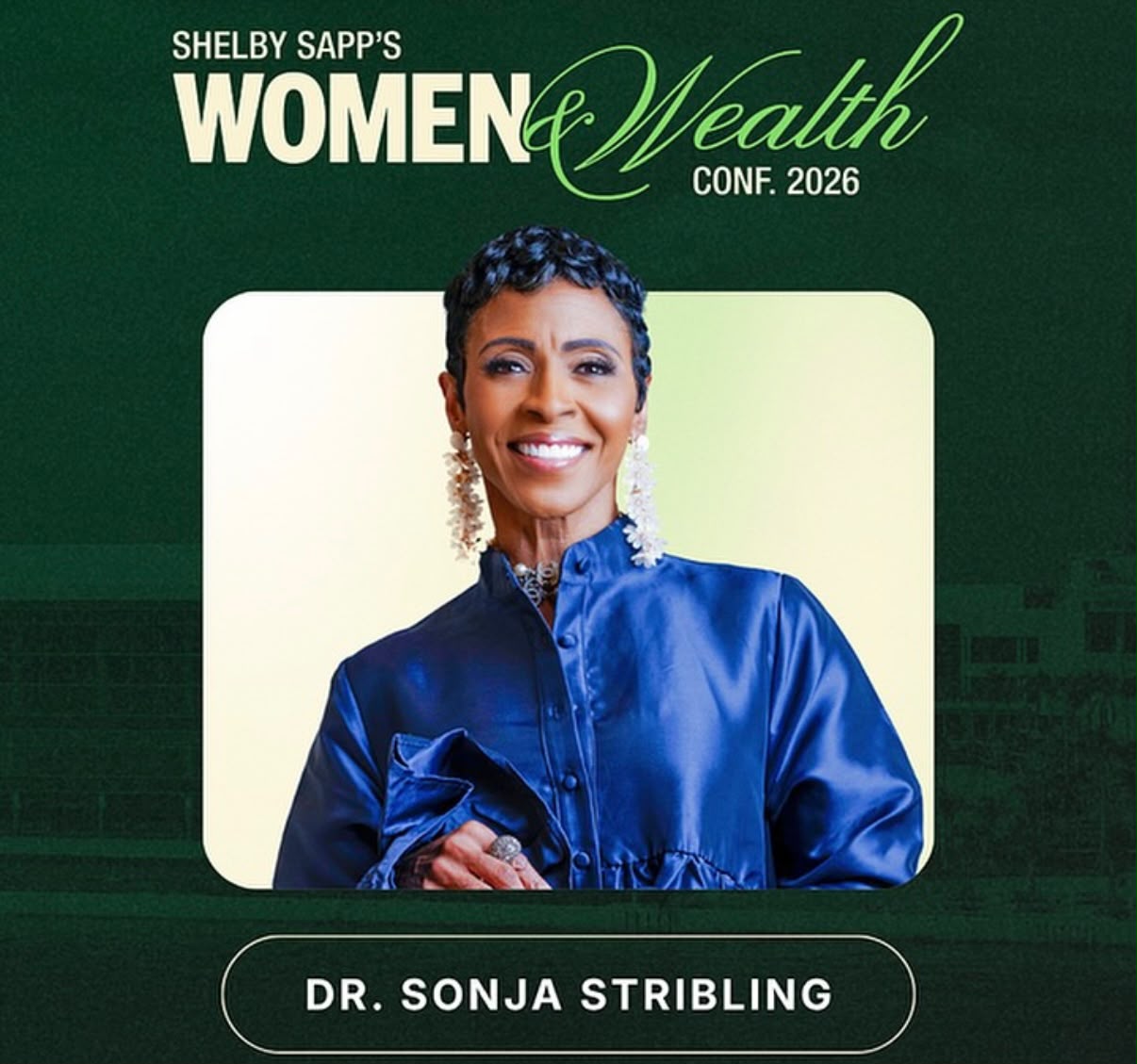
Dr. Sonja Stribling came back onto the Women & Wealth stage one more time and called what followed a big girl conversation.
This presentation felt different from her first two.
The first was about designing the woman we intend to become.
The second was about accountability, moving decisively, and having someone capable of catching us when we run at full speed.
This time, Sonja wanted to talk about what happens around us when we begin doing those things.
- What happens when another woman wins?
- What happens when someone makes a decision we would not make?
- What happens when our friends cannot understand where we are trying to go?
- What happens when people criticize us online?
- What happens when our ambition begins changing the rooms we need to be in?
And underneath all of those questions was another one.
Are we mature enough to build wealth together without turning another woman's success into evidence of our own inadequacy?
That is a conversation worth having.
But the sharpest line of the presentation was not about other women at all. It was about money, and it came near the end.
Taxes are the second biggest expense in life. Not knowing is the first.
That idea is strong enough to carry the whole presentation, and strong enough, as it turns out, to be aimed back at the presentation itself.
Success makes you more visible
Sonja opened with a warning.
The larger the impact you are trying to create, the more criticism you may eventually encounter.
I would phrase it slightly differently.
I do not think criticism is proof that someone has a great calling.
- Sometimes people are criticized because they are wrong.
- Sometimes because they behaved badly.
- Sometimes because the internet simply rewards conflict.
But increased visibility does mathematically expose us to more opinions.
If 100 people know you exist, there are only so many people available to dislike what you are doing. If 10 million people know you exist, criticism becomes almost inevitable.
So if we want a public brand, a large company, a visible leadership role, a major audience, or a meaningful platform, we have to develop some capacity for being misunderstood.
Otherwise, visibility becomes unbearable.
We are going to be talked about anyway
Sonja talked about the messages many women inherit.
- Be safe.
- Be quiet.
- Do not be too bold.
- Do not draw too much attention.
- Do not shine too brightly.
- Do not make people uncomfortable.
Those messages often sound like protection.
Sometimes they are. Historically, visibility genuinely carried different risks for women.
But protection can eventually become a ceiling.
If you are building a brand, company, movement, or public career, there will come a point when avoiding attention becomes incompatible with the goal.
Afnan Khalifa made this point from another direction in the previous presentation, covered in Part Eleven: the market cannot reward value it cannot see.
Sonja's version was more emotional. People may talk about you whether you build the thing or not.
So maybe the better question is this.
Whose opinion deserves enough weight to change my direction?
Everyone cannot have a vote.
Another woman winning does not mean I am losing
Much of Sonja's presentation came in response to criticism she had seen after the previous day's mastermind offer.
- Some people loved it.
- Some bought.
- Some did not.
- Some criticized it.
Sonja argued that women need to become better at separating another woman's decision from their own emotional reaction to that decision.
I agree with the larger principle. If another woman does any of the following, none of it automatically says anything about me.
- Gets promoted.
- Raises capital.
- Buys the house.
- Signs the client.
- Gets married.
- Leaves the marriage.
- Builds the company.
- Makes $1 million.
- Invests $25,000 in coaching.
- Decides she would never invest $25,000 in coaching.
I can celebrate her without copying her. I can disagree without resenting her.
That distinction feels increasingly important.
Support does not require agreement
This is where I would add some nuance to Sonja's message.
She interpreted some criticism as jealousy or frustration from people who could not participate.
That may sometimes be true.
But we should be careful about assuming every disagreement comes from envy.
Sometimes criticism is useful.
Someone can sincerely celebrate your success and still question the price, the business model, the investment, the contract, the strategy, the sales method, or the decision.
Healthy communities should make room for both.
Women supporting women cannot mean women never challenging women.
That would simply replace hostility with groupthink.
The better standard is a set of three questions.
- Can we disagree without becoming cruel?
- Can we question without diminishing?
- Can we celebrate another woman's agency while maintaining our own judgment?
That feels much stronger.
If this is not your community, find another one
One thing I appreciated was that Sonja explicitly told the women who did not purchase the mastermind that it was okay.
Maybe this is not the right time. Maybe this is not your community.
But then she added something: go find your tribe.
That part resonated with me much more than any specific program.
Because ambition can become lonely when the people around us cannot relate to what we are trying to build.
You start talking about customer acquisition, investing, scaling, hiring, cash flow, leadership, equity, ownership. And everybody around you wants to discuss something completely different.
There is nothing wrong with them. There is nothing wrong with you.
You may simply need additional rooms.
Your original friends do not have to perform every role in your life
This is something ambitious people sometimes struggle to accept.
- We want the childhood friend to become the business confidante.
- The sibling to understand our investment strategy.
- The spouse to be the coach.
- The college friend to become the co-founder.
- The person who knew us at 18 to naturally understand the person we are trying to become at 38.
Sometimes that happens. Often it does not.
Sonja used the metaphor that some people may run out of oxygen as you climb higher.
I would soften the metaphor but keep the lesson.
Not everybody has to make every journey with us.
- Someone can be a wonderful friend and a terrible business advisor.
- Someone can love us deeply and have no useful insight into the company we are building.
- Someone can belong in our life without belonging in every room.
That is not betrayal. It is specialization.
Find people who understand the altitude
Sonja said that if she could go back to being 27, she would spend much more time around the wealthiest and, importantly, wisest women she could find.
That second word matters.
Wealth alone is not enough.
I do not want advice simply from someone who has money. I want to know more.
- How did she make it?
- How did she keep it?
- What risks did she take, and what did she sacrifice?
- How does she treat people?
- What does her business look like behind the Instagram posts?
- What mistakes did she make, and what would she never do again?
- How does she think about taxes, investing, debt, partners, liquidity, and succession?
A wealthy person can teach you one path.
A wise person can help you determine whether that path should become yours.
Mentorship should compress mistakes
Sonja encouraged the room to find mentors who have already achieved what we want to achieve.
There is a strong economic argument for this.
Suppose I can spend three years learning something through trial and error. Or I can learn enough from someone experienced to reduce that process to one year.
The mentor did not give me two years of life. But she may have helped me avoid spending them making known mistakes.
That is what great education does. It compresses learning.
Books do it. Conferences do it. Courses do it. Advisors do it. Mentors do it. Employees with experience do it. Good lawyers and accountants certainly do it.
We are essentially paying for compressed experience.
The important word is good.
The expensive mentor is not automatically the best mentor
Price is not proof of quality.
Neither is popularity. Neither is proximity to celebrities. Neither is having a large social-media following.
Before investing heavily in mentorship, I would still want to know the answers to these.
- Has this person actually solved my problem?
- Are the results independently understandable?
- Can she teach what she knows?
- Are her incentives aligned with mine?
- Do former clients remain successful without her?
- Does the methodology apply to my business?
- Does she teach principles or dependency?
- Can I afford the investment without destabilizing myself financially?
The objective is not to spend the most. It is to reduce the cost of learning.
Be so good they cannot ignore you
One of Sonja's principles was this.
Be so good they can't ignore you.
I think this is the right counterbalance to obsessing over critics.
Because there are two possible responses when someone doubts us.
One is spending enormous amounts of energy proving the critic wrong. The other is getting better.
Better product. Better sales. Better customer service. Better margins. Better speaking. Better content. Better leadership. Better results.
At some point, performance becomes the response.
Not because everyone suddenly likes you. They may not. But competence becomes difficult to dismiss.
That is a much healthier target than universal approval.
Then came my favorite financial line of the presentation
Sonja asked the room what the two biggest expenses in life are.
People shouted answers. Housing. Children. Education. Weddings.
She said number two is taxes.
Then she asked what number one is.
Her answer:
Not knowing.
Obviously, this is not a literal accounting category. But the idea is excellent.
Ignorance can be unbelievably expensive.
What does not knowing cost?
- Not knowing how taxes work can cost money.
- Not knowing the contract can cost money.
- Not understanding the equity you gave away can cost millions.
- Not understanding interest rates can cost years.
- Not knowing your margins can allow a company with growing revenue to quietly lose money.
- Not understanding customer concentration can make one large client feel like security until the client disappears.
- Not understanding insurance can turn one event into a financial disaster.
- Not understanding estate planning can transfer chaos instead of wealth.
- Not understanding employment law can create lawsuits.
- Not understanding investments can lead to unnecessary fees, concentration, scams, or permanent loss.
- Not understanding your own financial statements means operating a business while partially blind.
Knowledge does not eliminate risk. It helps us see the risk before we step into it.
You cannot outsource understanding completely
We can hire lawyers, accountants, investment advisors, CFOs, tax professionals, and business managers.
That is smart.
But delegation does not eliminate the owner's responsibility to understand enough to ask intelligent questions.
- You do not need to become the accountant. You should understand what the accountant is showing you.
- You do not have to become the attorney. You should understand what you are signing.
- You do not have to become the portfolio manager. You should understand where your money is invested and why.
There is a dangerous version of wealth where someone earns substantial money while remaining financially illiterate. Eventually somebody else becomes the real decision-maker.
Knowledge protects agency.
And it is worth naming who is positioned to benefit from the gap. It is not a stranger. It is whoever you delegated to, whoever sold you the product, whoever drafted the agreement you signed without reading. Not knowing is rarely expensive in the abstract. It is expensive in the presence of someone who does know.
Which brings the idea back around
Here is the part I keep turning over, because I think it is the most useful thing available from this presentation and it is not what the presentation intended.
If not knowing is the single most expensive thing in life, then the most expensive not-knowing in a room full of offers is not knowing how to evaluate the offer in front of you.
There is one more thing worth stating plainly. Sonja is a business coach. The community she was recommending is a community she sells. That does not invalidate anything she said, and the advice to find people who have arrived where you want to go would be good advice from anyone. It just means the recommendation and the product point in the same direction, and it is worth holding both in view.
The return on this conference will come from what happens next
Sonja also criticized passive consumption.
Vision boards without action. Pictures of slides nobody ever reviews. Notes that never become decisions.
That connected back to the reason I started writing this entire Women & Wealth series.
It is incredibly easy to attend an event like this and mistake emotional intensity for transformation.
You feel different. Inspired. Focused. Possibility feels enormous.
Then you fly home.
- Monday comes.
- Email returns.
- Employees need things.
- Children need things.
- The calendar fills.
And within a week, the notebook is somewhere on a desk.
That is why I keep returning to one question.
What am I actually going to implement?
One useful change is worth more than 200 pages of notes nobody uses.
Celebrate publicly. Evaluate privately.
If I had to take Sonja's women-supporting-women message and convert it into a practical rule, this might be it.
When another woman wins, celebrate her. When you are considering making the same decision, evaluate it independently.
Those actions are not contradictory.
She bought the company, so the valuation must be reasonable.
I am thrilled for her, and I would never pay that valuation.
She invested, so the program must be worth it.
I celebrate her agency, and it is outside my risk tolerance.
Her marriage works, so that structure must be right.
I admire her marriage, and I want a different structure.
Her business is successful, so the model must be sound.
I respect her results, and I dislike the model.
Questioning it would make me unsupportive.
Support is celebrating her decision. It is not adopting it.
This criticism is probably jealousy.
This criticism might contain information. What would it cost me to check?
Maturity allows us to separate the person from the decision.
What I'm taking from Dr. Sonja Stribling's final presentation
- 01Visibility inevitably exposes you to more opinions. Build enough conviction to survive that without becoming immune to useful feedback.
- 02Do not automatically interpret criticism as jealousy. An explanation that fits every objection is not explaining anything.
- 03Another woman's success is not evidence of your failure.
- 04Supporting women does not require agreeing with every decision another woman makes.
- 05Celebrate another woman's agency while preserving your own judgment.
- 06Notice who benefits when you accept a frame, including a frame you agree with.
- 07If your existing environment cannot support your ambition, add new rooms rather than demanding everyone around you change.
- 08Distinguish the friend who cannot engage with your ambition from the friend who simply disagrees with it. The second one is valuable.
- 09Friends, family, partners, mentors, and business advisors can occupy different roles. One person does not need to be everything.
- 10Seek wisdom, not merely wealth.
- 11Use mentorship to compress learning and avoid known mistakes.
- 12Evaluate mentors on whether they solved your specific problem, not on price, popularity, or testimonials with no control group.
- 13Become so competent that performance eventually speaks louder than criticism, while remembering that being ignored is usually a distribution problem.
- 14Treat ignorance as a financial risk.
- 15Understand taxes, contracts, investments, financial statements, and business economics well enough to remain the real owner of your decisions.
- 16Belonging and economics are separate tests. A community can be right for you while the price is wrong for you this year.
- 17Do not confuse collecting information with implementing it.
- 18Celebrate publicly. Evaluate privately.
This is Part Thirteen
This is Part Thirteen of my Women & Wealth conference series, and the third time Dr. Sonja Stribling has appeared in it.
Her three presentations ended up forming an interesting progression.
- 01Design her.
- 02Who is catching you?
- 03Who is around you?
First, who are you becoming. Then, who is helping you move. And finally, who is standing around you while you become her.
- Do they challenge you?
- Celebrate you?
- Teach you?
- Distract you?
- Resent you?
- Expand you?
And are you capable of doing those same things positively for another woman?
Because building wealth is not an entirely solitary exercise.
We need customers, partners, employees, mentors, professionals, friends, communities, and people who know things we do not.
But the responsibility remains ours.
- Find the room.
- Ask the question.
- Learn the skill.
- Apply the information.
- Celebrate the woman beside you.
- Then keep building.
Because Sonja is right about one thing I think almost every entrepreneur eventually discovers.
Not knowing can become very expensive.
The good news is that ignorance is one expense we can continuously work to reduce. And the first thing worth knowing is how to tell a good offer from a persuasive one.
Topics
- Women & Wealth
- Mentorship
- Community
- Financial Literacy
- Sonja Stribling
Naihomy Navarro
Faith. Discipline. Elevation.
I write from Santo Domingo about building with intention: business, wealth, identity, and the decisions that hold everything else up.
Let's build something that lasts
If these ideas resonate, let's talk about collaborations and partnerships.
Connect