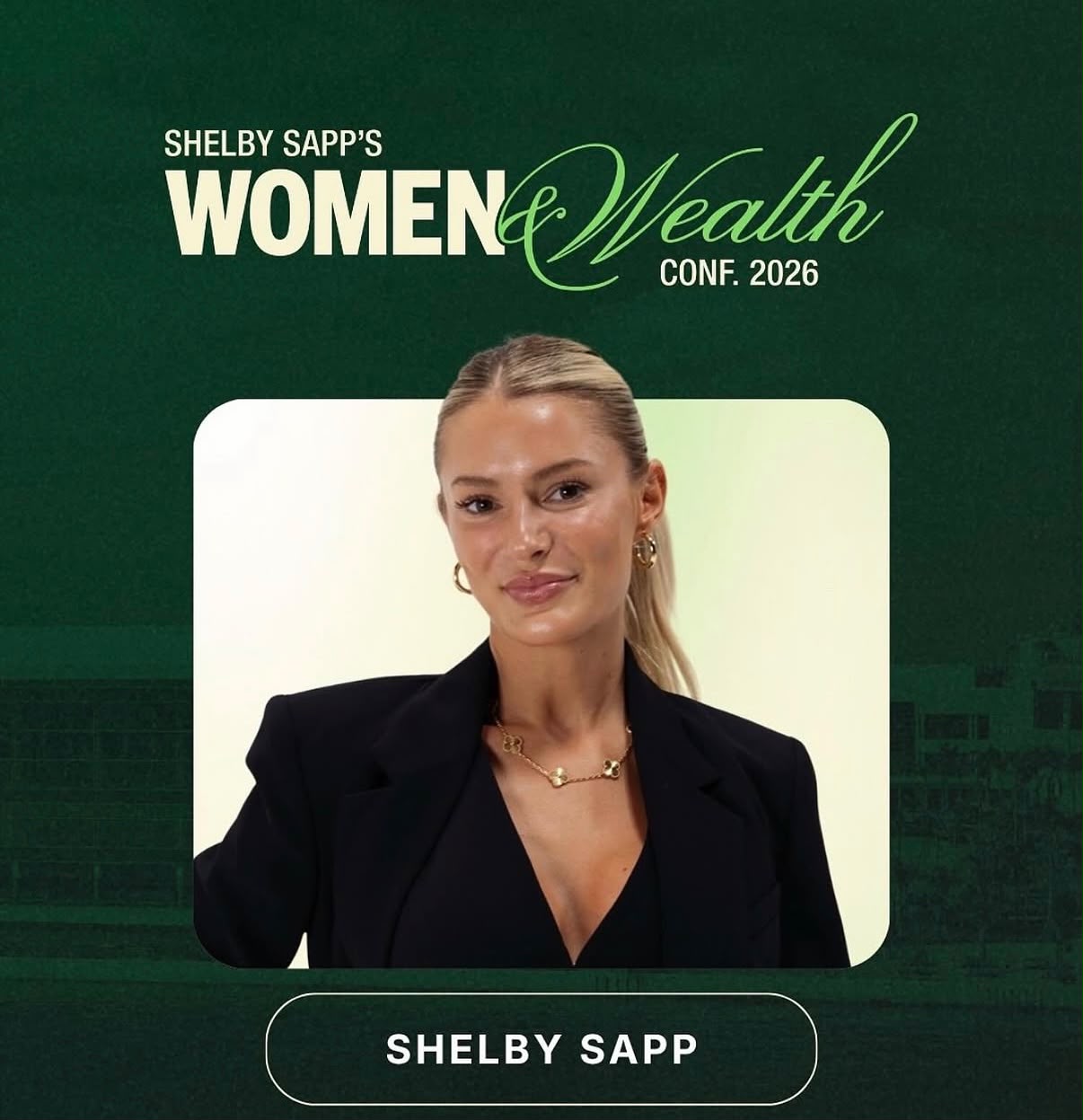
A few weeks ago, I packed my bags in Santo Domingo and flew to Fort Lauderdale for three days at Shelby Sapp's Women & Wealth Conference 2026.
My Old Money ticket was $1,200, but anyone who has traveled internationally for a conference knows the ticket is only the beginning. Once I factored in flights, accommodations, transportation, meals, clothes, shoes, makeup, and everything else that went into making the trip happen, my total investment was well over $8,000.
And yes, I'm counting the clothes, shoes, and makeup.
Because you know I cannot fly from Santo Domingo to walk into a room with thousands of ambitious and successful women from around the world half-stepping. Absolutely not.
Now that I've had a few weeks to come down from the excitement, go through my notes, reflect on the conversations, and think about everything I experienced, there's an obvious question:
Was it worth investing more than $8,000 to be there?
One thousand percent. Without question.
I would do it again, and knowing what I know now, I would do it even if the investment were twice as much.
That's not because every sentence spoken from the stage was revolutionary, because I agreed with every idea, or because spending thousands of dollars to attend a conference magically changes your life. It doesn't.
The value was in the connections I made, the knowledge I acquired, the conversations I had, the inspiration I received, and the opportunity to deliberately put myself in a room that challenged me to think bigger.
There are investments where the return is easy to calculate. You put in a dollar and get two dollars back. Simple.
Then there are investments whose returns may compound for years in ways that aren't immediately visible on a spreadsheet. One introduction can become a friendship, partnership, client, or opportunity. One conversation can completely change how you approach a problem. One idea can change the direction of a business. One person can introduce you to a room you didn't even know existed.
And sometimes, simply seeing thousands of women building businesses, accumulating wealth, taking risks, negotiating, investing, reinventing themselves, and pursuing extraordinary goals reminds you of what's possible for your own life.
Being in the room was part of my investment. What I do because I was in the room will ultimately determine the return.
That's why I'm writing this series.
I'm Not Letting These Notes Die in a Notebook
You know how conferences go. You arrive excited, take pages of notes, photograph slides, underline things, put stars next to quotes, meet incredible people, and leave feeling like you're about to change your entire life.
Then you get home.
Emails. Meetings. Responsibilities. Deadlines. Life starts moving again, and eventually that beautiful notebook full of ideas ends up sitting somewhere on your desk.
I refuse to let that happen with Women & Wealth.
Over the three days, I listened to presenters speak about sales, business, money, investing, branding, identity, confidence, leadership, influence, and wealth. So I'm going back through every presentation and doing something I believe is more valuable than simply rereading my notes.
I'm processing what I heard.
For every speaker, I want to examine what I actually learned. What was worth remembering? What challenged the way I think? What can I apply? What do I disagree with? What requires more research?
And, most importantly: what am I actually going to do differently because I learned it?
Because inspiration feels incredible inside a conference room.
Implementation is where the ROI begins.
It only makes sense to start this series with the woman who created the room: Shelby Sapp.
Shelby Sapp: Sales Is Bigger Than Selling
Shelby's opening presentation centered around one big idea:
Sales isn't simply a profession. Sales is a life skill.
Initially, that sounds like something you'd expect a sales trainer to say. But as she unpacked it, I understood what she meant.
We're selling constantly.
We sell ourselves when we walk into a room. We sell our value when we negotiate. We sell our ideas when we need someone else to believe in something that doesn't exist yet. We sell our capabilities when pursuing opportunities, and we sell possibilities when we lead people.
Entrepreneurs routinely have to sell a future before that future exists. Leaders have to transfer belief before everyone else can see the outcome.
And sometimes the most difficult sale we'll ever make is convincing ourselves that we're capable of becoming the person required to achieve what we say we want.
Shelby organized her presentation around three ideas:
- 01Selling yourself
- 02Selling others
- 03Selling your vision
The more I thought about those three concepts, the more I realized this wasn't only a sales framework. It was also a framework for identity, influence, and leadership.
First, You Have to Sell Yourself
Shelby told us about the beginning of her sales career, when she was dropped off in a neighborhood in Minnesota to sell pest control door-to-door.
She was terrified. Door after door, she heard no. People slammed doors in her face, and eventually, frustrated and defeated, she called her mother.
Her mom listened to her pitch and pointed out something important: the problem wasn't necessarily what Shelby was saying. It was how she was saying it. Her words communicated that she didn't want to be there.
Her mother challenged her to approach the next door believing that person was going to buy. Shelby did, and the next person became her first sale.
- Same salesperson.
- Essentially the same script.
- Different mindset.
- Different energy.
- Different result.
Shelby's point was that sales is heavily influenced by the energy, conviction, and confidence behind your words. I think that applies to far more than selling products.
You can have the qualifications. You can have the business. You can have the idea. You can have the opportunity. But if you're communicating from a place that says, I'm not sure I belong here, people can often feel it.
That led into one of the most useful parts of her presentation: how do you actually build confidence?
Confidence Needs Receipts
We're constantly told to believe in ourselves, think bigger, know our worth, and walk into the room like we belong there. Those are great sentiments.
But how?
Shelby connected confidence to identity. The labels we repeatedly assign ourselves influence the evidence we pay attention to.
If my identity is I'm terrible at sales, every rejection becomes evidence supporting that belief. See? I knew it.
But if my identity becomes I'm becoming an excellent salesperson, I can interpret that same rejection differently. Maybe the pitch needs work. Maybe I asked the wrong questions. Maybe that prospect wasn't qualified. Maybe I simply need more practice.
Then, when I get a win, I have another piece of evidence supporting the identity I'm building.
This is where I would add an important distinction of my own:
Confidence needs receipts.
I don't believe confidence is simply standing in front of a mirror and repeating something until it becomes true. You build it by accumulating evidence.
One difficult conversation you didn't avoid. One negotiation where you asked for more. One client you closed. One boundary you maintained. One presentation you delivered despite being nervous. One promise you made to yourself and actually kept.
Those are receipts.
The evidence begins accumulating, and eventually you're no longer trying to convince yourself that you're capable. You've shown yourself that you are.
Treat Your Limiting Beliefs Like Sales Objections
This was one of my favorite connections Shelby made.
Salespeople expect objections:
- It's too expensive.
- I need more time.
- I'm not ready.
- I need to think about it.
But what about the objections we give ourselves?
- I'm too young.
- I'm too old.
- I'm not experienced enough.
- I'm not outgoing enough.
- Why would they choose me?
- Who am I to do this?
- It hasn't worked before.
- Maybe I'm not ready yet.
Shelby's argument was that we should learn to handle our internal objections just as deliberately as a trained salesperson learns to handle a customer's objections.
Why me?
Why not me?
I've never done this before.
Then I'm about to learn how.
It hasn't worked yet.
What has everything I've tried taught me about what I should do next?
That doesn't mean ignoring reality or pretending obstacles don't exist.
It means refusing to treat every fearful thought that enters your mind as an objective fact. A thought can be examined. A belief can be challenged. An assumption can be tested. And sometimes, an objection can be overcome.
Manifestation Isn't Enough
Shelby also talked about manifestation and shared stories about things she had once envisioned for herself that later became part of her life. But she made a distinction that I appreciated.
She didn't credit Pinterest boards with building her life. She credited action and sales. Her phrase was manifest action.
Have the vision. Set the goal. Picture what you want. But then put action behind it.
I can create the most beautiful vision board in Santo Domingo. I can journal about the woman I want to become. I can visualize the business, financial freedom, impact, relationships, and life I want.
Eventually, though, I still have to make the call. Send the email. Learn the skill. Negotiate. Ask. Invest. Risk hearing no. Walk into the room.
Sometimes I have to buy the $1,200 ticket, spend more than $8,000 all-in, get on the plane, and go.
Vision can tell us where we're going. Action is what moves us there.
Selling Others: Stop Talking and Start Asking
The next part of Shelby's presentation moved from mindset into actual sales technique, and one lesson stood above almost everything else: stop talking so much about what you sell.
She used the famous sell me this pen exercise.
An inexperienced salesperson immediately starts describing the pen. It's beautiful. It's gold. Look at the nib. Look at the design. Look at all these features.
A trained salesperson does something completely different. She asks a question.
What would you use the pen for?
That changes the entire conversation because until I understand what you need, I don't actually know what I'm selling you.
Nobody cares about your product as much as you do
Entrepreneurs can easily fall into this trap.
We become obsessed with our products and services. We know every detail, feature, improvement, hour invested, and sacrifice involved in creating what we offer. Because those things matter deeply to us, we assume they should matter equally to our customers.
Usually, they don't. The customer is primarily wondering: what does this do for me?
That's the difference between features and benefits.
- A pen is a writing instrument. But perhaps to an executive signing important contracts, the right pen represents professionalism and reputation.
- Marketing isn't simply marketing. Perhaps it's predictable customer acquisition.
- Software isn't simply software. Perhaps it's ten hours returned to someone's week.
- A financial strategy isn't simply numbers. Perhaps it's peace of mind.
The thing you're selling is often just the vehicle. The outcome is what people actually want.
Features tell. Benefits sell.
Find the Gap
Shelby introduced the concept of gap selling. At its simplest, you need to understand two things: where is this person now, and where does this person want to be?
Everything between those two points is the gap.
Instead of immediately presenting a solution, ask questions. What's happening right now? What's frustrating you? What have you already tried? Why isn't that working?
Then start exploring the desired outcome. What would the ideal situation look like? What changes if the problem disappears? Why does that outcome matter?
Once you understand both sides, you can determine whether what you're selling genuinely bridges the gap. That's an entirely different approach from memorizing a script and waiting for your turn to speak.
It requires something many of us could probably improve at: listening.
What Is the Problem Actually Costing You?
One point I particularly liked was the importance of quantifying a problem.
Instead of simply accepting, this is frustrating, go deeper.
How many hours does it cost? How much money? How often does it happen? What opportunities are being lost? What is the emotional cost? What happens if nothing changes for another six months?
A problem becomes much easier to evaluate when we understand what it's actually costing us. And this isn't only useful in sales. I think it's a powerful decision-making framework for our own lives.
How much will this solution cost me?
How much is staying exactly where I am already costing me?
Those are two very different calculations.
In many ways, that question also applies to my decision to attend Women & Wealth. Spending more than $8,000 was significant, but cost wasn't the only side of the equation. There was also the cost of not going.
What connections might I miss? What ideas wouldn't I hear? What conversations wouldn't happen? What opportunities might never exist because I wasn't in the room?
That doesn't mean every expensive opportunity is worth pursuing. Far from it.
It means price and value are not always the same thing.
Not Everyone Values the Same Thing
Shelby shared another lesson from her door-to-door sales days.
When she first started selling in wealthy neighborhoods, she used essentially the same pitch she'd used elsewhere: save money, get a discount, pay less. It wasn't working.
Then she realized something simple but important: not everybody values the same currency.
One person might care deeply about saving $20. Another might gladly spend $100 to save 20 minutes. Some people optimize for money. Others optimize for time, convenience, privacy, status, security, certainty, speed, freedom, reputation, or peace.
A good salesperson doesn't assume she knows which one matters. She asks.
I think that lesson applies far beyond sales. We make mistakes in relationships, business, leadership, and communication when we assume other people value what we value. Understanding what matters to the person in front of you changes the conversation.
Stop Being Afraid of Objections
Then Shelby moved into one of the most feared parts of sales: objections. Price. Timing. Trust. Fear.
- I need to think about it.
- I need to speak to my spouse.
- I don't need it right now.
Her first point was incredibly practical. These objections aren't surprising. They're predictable.
If you sell something regularly, you've probably heard variations of the same five or six objections dozens of times. So why act shocked every time one appears? Prepare for them. Study them. Understand what's underneath them.
And instead of immediately defending your product, get curious.
- If someone says something is too expensive, compared with what? What is the existing problem currently costing them?
- If they don't have time, what might delaying the solution another six months cost?
- If they need to think about it, what specifically still feels unresolved?
An objection doesn't automatically mean the conversation is over. Sometimes it means there is something that hasn't been sufficiently understood.
Selling Your Vision: Why Before What
Shelby's third major idea moved beyond selling ourselves or individual products. It was about selling a vision. Her framework was:
- 01Why
- 02How
- 03What
Most of us communicate in the opposite direction.
Someone asks, what do you do? And we answer with the product.
- I sell consulting.
- I own a beauty company.
- I teach sales.
Those answers explain what we do, but they don't necessarily explain why anyone should care.
Shelby's argument was that powerful brands and movements begin with why. What do you believe? What change are you trying to create? Why does your company need to exist? Who becomes better because you built it?
Then explain how you accomplish that mission. And finally, explain what you sell.
That distinction made me think about the difference between a product and a vision. Your product can simply be one vehicle through which your vision becomes real.
When the Vision Becomes Bigger Than You
This might have been my favorite idea from Shelby's entire presentation.
A real vision eventually becomes bigger than its founder.
Other people begin to see themselves inside it. That's when a business can become a community, a platform can become a movement, and an individual ambition can create opportunities for people the founder may never even meet.
When we're talking about wealth, that distinction becomes particularly important. Because generational wealth, by definition, cannot only be about you.
Eventually the question becomes: what are you building that continues beyond you?
Assets. Businesses. Knowledge. Relationships. Access. Opportunities. Standards. Education. Perhaps most importantly, a completely different starting point for the people who come after you.
That's where wealth becomes bigger than a number in an account.
And as someone who flew to this conference holding a ticket literally labeled Old Money, that question stayed with me.
What am I building now that can become somebody else's foundation later?
That's a much bigger conversation than income.
What I'm taking home from Shelby's presentation
- 01Sell yourself before expecting anyone else to buy into you.
- 02Build confidence through evidence, not affirmation alone.
- 03Treat limiting beliefs as thoughts that deserve examination rather than automatic obedience.
- 04Put action behind your vision.
- 05Ask before you pitch. Diagnose before you prescribe.
- 06Sell outcomes rather than features.
- 07Understand what the person in front of you actually values.
- 08Quantify the cost of leaving a problem unsolved.
- 09Expect objections without fearing them, but don't treat every no as something you are entitled to overcome.
- 10Know your why, and build a vision big enough that other people can see themselves inside it.
If I had to condense the entire presentation even further, it would be this:
Believe. Ask. Listen. Diagnose. Act. Communicate. Build.
So, Was My $8,000+ Investment Worth It?
This is only the first presentation I'm unpacking, and my answer is already the same. Yes. One thousand percent.
But I don't think the return on my $8,000+ investment was delivered to me at the conference.
I think I was given raw materials.
Ideas. Connections. Knowledge. Perspective. Relationships. Inspiration. Questions. Possibilities. What those things eventually become depends on what I do with them.
That's the part of conferences we don't talk about enough. Buying the ticket isn't the return. Showing up isn't the return. Taking pages of notes isn't the return. Those things give you access to the opportunity.
The real test begins when you return home.
I flew back to Santo Domingo with more than a suitcase full of clothes and a notebook full of notes. I came back thinking bigger. I came back with new relationships, ideas I want to explore, and an even greater appreciation for deliberately putting yourself in rooms where the conversations, expectations, and possibilities stretch you.
Would I spend more than $8,000 to do it again? Without hesitation. Would I do it if the investment were twice as much? Knowing what I know now, yes.
But now comes the part that matters: making the investment pay dividends.
This Is Only Part One
This is Part One of my Women & Wealth Conference series.
I'm going through the presenters one by one, but I don't want these articles to simply become cleaned-up versions of my conference notes. I want to unpack the ideas, pull out the practical lessons, challenge what deserves challenging, research what deserves a deeper look, and document what I'm actually applying afterward.
At the end of this series, I'll return to the question I started with: what did more than $8,000 actually buy me?
But I suspect there's an even more important question.
What did I build with what I brought home?
That's the ROI I'm interested in.
Topics
- Women & Wealth
- Sales
- Mindset
- Wealth
- Shelby Sapp
Naihomy Navarro
Faith. Discipline. Elevation.
I write from Santo Domingo about building with intention: business, wealth, identity, and the decisions that hold everything else up.
Let's build something that lasts
If these ideas resonate, let's talk about collaborations and partnerships.
Connect